Dreaming His Dreams

Several weeks ago, I stumbled across a yellow legal pad that has been at the center of those meetings. On it, we’ve chronicled our goals for the past eleven years. On it, we’ve strategized and organized and neatly categorized them into 1-year, 5-year, and 10-year plans. Some have been eerily prophetic; others, hilariously naïve. Our first year's goals included eventually owning “forty acres of land” (because as my father-in-law says, “They’re not making any more of it.”) and having “a couple kids.” Today, we own ½ acre and don’t “have kids” but we are a family that includes three marvelously creative and unique individuals, none of whom I could have imagined ten years ago.
Looking over that legal pad reminded me of two things--- 1) how foolish we are to think we can plan our own paths 2) how kind and wise God is to give us dreams that He wants to fulfill
I grew up in a church tradition that, while perhaps unintentionally, was often suspicious of personal dreams and ambition. We had just two choices on the shelf, after all—pleasing God or pleasing self. And while I don’t really believe it was intended to be that simplistic, to an impressionable teenager, this often presented itself as the need to choose between doing what God wanted and doing what I loved. What no one seemed to clarify was that a life well-lived would undoubtedly involve both.
My parents believed in dreams though. And they believed in Providence--the kind of Providence that made each of their five children unique and would ultimately lead each to very different callings from finance to design to music. They never pressed the false dichotomy that I felt but instead taught us that all of life was to be lived with joy and faith, all of life was to be lived for His glory regardless of what we ended up doing. Still I don’t think it really sunk in for me until adulthood. I remember privately agonizing through high school, desperate to prove to God and myself that I would follow “His will” if only He would reveal it to me.
All the while never realizing that He already had and I already was.
In fact, as I look back, I realize that I was doing His will every time I followed in obedience, every time I loved another person, every time I longed to see His glory. I also realize that I was doing His will every time I sat down to write, every time I read and reread books that stretched my thinking, every time I reveled in and pursued the dreams that He had already placed inside of me.
Eighteen months ago, I began blogging, in part to finally prove or disprove this theory. I wanted to fully commit myself to a dream in order to see what He would do with it. I guess, in a way, I wanted to put my big toe in the Jordan to see if the waters would part. To that point, I had been writing bits and pieces but only as a hobby. I think it was my way of not having to commit, a way of inoculating myself from disappointment. What if my dreams weren’t God’s dreams for me? What if I failed? I would just play it safe; and while that meant that I may never know what God could have done, I would also never have to face the possibility of seeing my dreams crushed.
But I soon found that I couldn’t play it safe. Every article I wrote and every query I sent flamed the passion that was burning inside of me. And slowly I realized that God Himself was the one nurturing and cultivating my dreams. He faithfully sent the right people to encourage me and faithfully sent the right rejections to keep me in my place; until one day, He finally gave me the courage to accept that as much as I loved writing, He loved me writing as well.
Back to the yellow legal pad. One of those silly goals that my husband and I wrote down over ten years ago was that I would write a book. Shortly before Christmas, in large part due to blogging, I signed a contract with Moody Publishers to write that book. I signed a contract that will enable me to do what I love at the same time that it will serve His people on a broader scale. I signed a contract that will enable my thoughts to be embodied in paper and ink and type and give me a chance to truly earn the appellation of “writer.”
I am humbled. I am grateful. I am scared. And I have never before so strongly believed in Providence.
The next several months of writing will probably be similar to the last several years—I expect to wrestle through fears, doubt, and discouragement, to swing from heights of elation to depths of despair. And while I have plenty more that I want to share about this unbelievable opportunity, at this point, I just want to sit in awe. To publicly acknowledge the kindness and wisdom of God and to remind myself that the God who gives dreams doesn’t abandon His children in the middle of them.
Each of us has different dreams; and each of our yellow legal pads should have different goals on them because He was made us distinct. Writing may not be your passion, but it is essential that you pursue whatever is. It is essential that you surrender not only to what you love but to the fact that God wants to use what you love for His kingdom. It may not end up being your profession, but it will be your calling. It will be something that only you can do--something that only you can contribute.
So this year--in this brave new world of 2013--find what you love to do, surrender to His hand, and know that a kind, sovereign God put those dreams inside of you in the first place. And because He has, this same kind, sovereign God will, in His own way and in His own time, bring them to pass. Not simply for your joy, but for the joy of His people, and I’m convinced, for His own joy—for His own secret delight in watching His sons and daughters become all that He has created them to be.
____________________________________________________________________________________________________ *Just noticed that the comments are marked as closed--struggling through some technical difficulties with my hosting service. Feel free to leave thoughts and comments on Facebook or Twitter. Hope to resolve the issue soon!
Mad Men, June Cleaver, and Biblical Womanhood
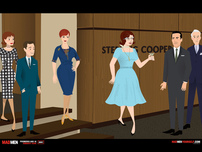
For some this may sound like a confession of moral laxity; for others it’s a confession of being horribly out of touch and having lived the last five years in a cave. Still, apart from the rampant licentiousness, unchecked greed, and ubiquitous alcoholism, I have to admit that it’s a pretty engaging show, especially as it captures the glamour of mid-20th century Manhattan--the perfect pencil skirts, the tailored three-piece suits, the sleek cars, and the poolside lunches at the Astoria. In its attempt to be historically accurate, Mad Men is also quick to make (and overstate) the point that this was a world dominated men, a world where housewives were vacuous ninnies, and the only women with any sense of power were the “hens” at the office who knew how to get a man to do what they wanted.
Of course Mad Men is interesting in itself, but it’s been particularly interesting as my exposure to it coincides with the ramped up conversation surrounding traditional gender roles. With this week’s release of Rachel Held Evans’ A Year of Biblical Womahood, everybody and her cousin seems to be parsing conservative interpretations of gender via the late 1950s and early 60s. Evans explains how she understands conservative mores here:
"The term 'Biblical womanhood' is basically a reaction to feminism. It means a woman who stays home and submits to her husband. It's a remembrance of June Cleaver—not what we see when we actually read scripture."
Now I can’t speak to Evans’ experience, but this correlation is funny to me. It’s funny because, despite being a woman who identifies as a conservative, I’ve never once thought of myself as June Cleaver. And the main reason isn’t because there’s anything wrong with June or even with women who care for their families fulltime. (I’m a SAHM myself.) The main reason my conservative understanding of gender has never led me to recreate the 1950s is because of what was happening below the surface. In a word, June was June, not because of conservative gender roles or because she stayed at home; June was June because of what broader society was pursuing at the time—stability and comfort.
June Cleaver vs. Kingdom Values During the 1950s, the United States experienced relative peace and prosperity for the first time in over two decades. In this context, Ward and June became icons of stability, comfort, and ease; they represented a generation who had known deprivation their entire lives, who as children had endured the Great Depression, and who came of age through the atrocities of WWII. By the time the 1950s rolled along, they were also a generation desperate for “the good life.” In this context, a woman’s role was naturally reduced to being a comforter, a nurturer, a source of emotional stability the same way that a man’s role was reduced to being a source of financial stability. (Think how important it was for a man who had grown up in the leanness of the Depression and watched his mother and sisters work in the factories during WWII to be able to make enough money to enable his wife to stay at home. And think too how important it would have been for women--who only a decade before had welcomed broken men home from war--to provide them with some sense of domestic normalcy and peace.) In this sense, gender roles weren’t simply about men oppressing women as so many Millennials think—although as Mad Men is quick to point out it was very easy for selfish men to do so--no, gender roles of the 1950s were a way to work toward the societal values of rest and stability.
So here’s my question: Is June Cleaver really synonymous with a conservative Christian understanding of gender?
I grew up in a very traditional home. I was taught to respect my father as head of the family and my mother spent years at home caring for us. But despite being traditional in their understanding of gender, my parents were very non-traditional in their view of the world. Instead of teaching their children to pursue stability and comfort, they taught us to love God, to sacrifice for his kingdom, to seek heaven’s riches over those of this earth, and to never forget where we were heading. The effect was that these kingdom dynamics created a different paradigm in which I applied conservative gender norms. Instead of thinking that the greatest good for me was to marry, have children, and rear them in a comfortable suburban environment, I grew up believing that the greatest good for me was to follow Christ, to devote myself to His service. That might very well mean marriage and children, but it could have as easily meant working overseas, pursuing post-grad degrees, or relieving the sick and oppressed. June Cleaver never once entered the conversation.
So I don’t think the problem is as simple as conservative gender roles. The problem comes when we use conservative gender roles to further our own comfort, our own sense of stability, or our own sense of ease. And my guess is that this is what many of my peers are confusing when they associate a conservative reading of gender with the 1950s. Ironically, conservatives fall prey to the same mistake when they insist on shaping applications of gender after a Cleaver-esque domesticity.
No Stepford Wives Because let’s be clear on one thing: the kingdom dynamics of love and sacrifice call us to apply gender roles very differently than we would if we were pursuing lives of ease and stability. When you believe that you’re pioneering a new country, when you believe that you’re pushing back the boundaries of brokenness, when you believe that you are fighting to see the kingdom of God reign in the hearts of men, it’s highly unlikely you’ll be content as June Cleaver.
Instead your role models for womanhood will be women like Katharina von Bora, who singlehandedly managed her family estates thus enabling her husband (Martin Luther) to do nothing less than turn the known church on its ear. Your role model for womanhood will be Abigail Adams, great-granddaughter of Puritans, whose minister father insisted on her education and who by her intelligence and grace helped her husband (and son) establish the very foundations of our fledgling government. You’re more likely to look to a woman like Caroline Ingalls who sweated alongside her husband, built her home with her bare hands, plowed fields, and tamed the frontier all for the sake of a dream. And you’re more likely to model your understanding of Christian womanhood after someone like Elisabeth Elliot who rejected the opportunity to be June Cleaver and went instead with her husband to live and die in the jungles of Ecuador--all to tell those who had never heard that Jesus lives.
These were no Stepford wives.
And yet, neither were they feminists in a political sense. (As a former nun, Katharina von Bora’s most revolutionary act was marrying and having children.) No, they were simply strong women who embodied all that it means to be human—they embraced their femininity, their capacity to bear and nurture life, their minds, their husbands, and their individual callings all in pursuit of goals and glories greater than their own private issues.
Deeper Issues Today, the easiest way to undermine a conservative understanding of gender is to align it with 1950s domesticity—something that that both liberals and conservatives are prone to do. But we must acknowledge that applications of gender are simply an expression of deeper values; poor June Cleaver was really only ever a presenting issue. The deeper question is what is driving us: Are we being motivated by our own needs or our own fears? Are we looking for lives of ease and comfort? Are we willing to use others to achieve that for ourselves?
Or are we pioneers, pilgrims on a journey from this world to the next? Are we men and women working together in pursuit of the kingdom of God? Are we captured by a greater vision and a greater dream of what God is doing in the world? When our churches are motivated by finding comfort in this life, it’s very possible that we would end up recreating a 1950s context; but as we concern ourselves with service and love, as we valiantly pursue the kingdom, June Cleaver with all her niceties and comfortable stability will have little place in the conversation. Until then, let’s put a moratorium on associating her with a conservative understanding of gender; and as a first step to that end, maybe we should all watch a little less Mad Men from now on.
My Take: DIY, Pintrest, and the Rise of the New Domesticity

In the past when we dreamed of our ideal (then non-existent) house, we always envisioned a room devoted to creating--whether it be crafting, sewing, drawing, writing, or simply playing with play-dough--we wanted a room that invites you to find your inner creative muse and let lose. Instead of fussing at my daughter for yet again cluttering up her room with odd bits of construction paper and glue, I want to be able to point her to cupboard of paints and glitter and chalk and say, “Go for it.”
I don’t know if other people dream of rooms like this, but I have noticed a trend among my generation. More and more of us are devoting our time and energy to things like crafting, cooking, and frugal living. You only have to hop on etsy, pintrest, or any number of DIY blogs to know that this phenomena is larger than any one subset and isn’t contained to the SAHMs among us. Women everywhere—from university-educated vegans to crunchy conservative homeschooling moms—are embracing the domestic.
In this Washington Post piece, Julia Rothman worries that this “new domesticity” will lead to obligation and foster a whole batch of June Cleavers trying to one up each other, not necessarily with our meatloaves and kitten heels, but with knit scarves and cheese making. And while this is definitely a possibility, I think the new domesticity can actually teach us something deeper about ourselves, if we let it.
Because whether it’s being motivated by a case of burn-out in the boardroom, a commitment to staying home with young children, or simply trying to make ends meet in these difficult economic times, this renewed interest in the creative process is really about reclaiming something very fundamental to our humanity. Whether you realize it or not, it’s about reclaiming the image of God in us.
In the case of my peers, generally young Christian women, the return to crafting and baking and decorating has accompanied a renewed emphasis on the importance of family life. We see marriages crumbling around us, children struggling through cookie-cutter schools, and so for many, the solution comes by devoting themselves full-time to their families. They’re educated women with more than a heaping of gifts, but they choose to become SAHMs because they really believe that, at least in the early years, they can best care for their families there.
But the truth that many are learning the hard way is that staying at home isn’t without sacrifice. In the eight years that I’ve been at home, I’ve discovered that little ones don’t often want to discuss French existentialism or world events, and major life accomplishments have been reduced to having everyone clean and fed at the same time. It doesn’t take very long to realize that staying at home can be less than stimulating.
In her breathtaking essay “Are Women Human?,” Dorothy L. Sayers argues that this is one reason why so many women pursue professional careers in the first place (a novelty in 1938 when she first gave the speech that would eventually be published as an essay). She says:
It is all very well to say that woman’s place is the home—but modern civilization has taken all the pleasant and profitable activities out of the home, where the women looked after them, and handed them over to big industry, to be directed and organized by men at the head of large factories…
It is a formidable list of jobs: the whole of the spinning industry, the whole of the dyeing industry, the whole of the weaving industry. The whole catering industry…the whole of the nation’s brewing and distilling. All the preserving, pickling and bottling industry, all the bacon-curing. And (since in those days a man was often absent from home for months together on war or business) a very large share in the management of landed estates…
Now it is very likely that men in big industries do these jobs better than women did them at home. The fact remains that the home contains much less interesting activity than it used to contain… It is perfectly idiotic to take away woman’s traditional occupations and then complain because she looks for new ones. Every woman is a human being—one cannot repeat too often—and a human being must have occupation, if he or she is not to become a nuisance to the world. Sayers concern was not really to define what constitutes a “woman’s” job or a “man’s” job but to emphasize that every human being—of which half the species are women--MUST be engaged in creative, productive work because they are made in the image of a creative, productive God.
So I’m wondering, especially in the case of my peers, how much of the return to domestic creativity has less to do with our need to care for our families and more to do with caring for our own souls? How many of us craft and sew not primarily because we can do it better or cheaper, but because we simply love to do it? And for women who don’t stay at home, how much of your drive toward the new domesticity comes from the fact that the modern workplace has forced us to become mechanistic, unimaginative robots, spending most of our days processing bureaucracy and paperwork, without ever seeing tangible progress for our labor?
This is why we’re seeing the resurgence of creativity, especially in the home. Ultimately, we create because He did. We love beauty because He does. And when those things are less and less present in our lives, we are driven to find a way to recover them—whether we realize that’s what we’re doing or not.
This is not a problem. Domestic arts do often allow us to better care for our families. And creative pursuits do fill a need and enable you to return refreshed to the humdrum of work on Monday. It’s also not a problem if your creativity doesn’t take the form of traditional domesticity—feel free to go rebuild the engine of that ’57 Chevy this weekend—because ultimately what’s at stake isn’t that we all become June Cleavers; it’s that we all become like our God.
In the end, we must recognize that we pin and we plant and we bake and we knit, not simply because we are women or mothers, but because we are human beings made in His image. And all the mechanization, all the industrialization, all the assembly lines in the world can’t remove that part of us that needs first to create, and then to step back with satisfaction and declare, “That’s good.” Just like He once did so very long ago, just like He continues to do every day.
Keeping Up Appearances
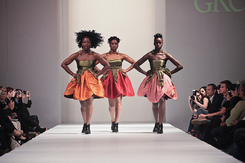
So I’ve been watching the industry with a wary eye and following the cultural conversation surrounding it. A lot of talk has centered on the inferiority that normal women feel when they compare themselves to air-brushed, tummy-tucked, photo-shopped and CGI enhanced models. Because while no one’s staging Occupy The Catwalk, beauty--in many ways--has become as exclusive as wealth, with the majority of it being held by the 1%.
In response, companies like Dove have launched “real beauty” campaigns, supermodels themselves have begun talking about the pressures of the industry, and the internet is full of memes contrasting a busty Marilyn Monroe with today’s waif-like fashionista. It seems like the solution to beauty inequality has been to promote inclusive beauty—everyone’s simply beautiful in their own way. Yet for all the discussion, for all the public service announcements, we don’t seem to have made much progress as a culture. And I think it’s simply because we’re not being honest with ourselves. We haven’t yet acknowledged what drives this industry--what drives us as human beings. We haven’t yet touched the darker side of our nature.
Because false definitions of beauty aren’t the problem--jealousy, covetousness, and lust are.
Only this morning I was flipping through my latest edition of Real Simple—not an industry standard by any stretch—and interspersed among the typical “balance your life and achieve perfection ads” were a couple of ads that struck me because of their transparency. One was selling Jones New York jeans with the tagline, “Keeping Up with the Jones’ [sic]” and the other was a spread for Sephora skincare. Their tagline? “Skin So Bright You’ll Make Everyone Else Look Dull.”
Finally, here is the truth. Because if we are really honest, the fashion and beauty industry isn’t propelled so much by becoming a better me, as it’s propelled by becoming better than you.
You see, we human beings have a difficult relationship with beauty. It’s not enough for us to simply appreciate it from a distance. No, we must possess it, we must own it, we must have it exclusively. And so while a man may lust after a woman, desiring to physically possess her beauty, women just as quickly lust after each other’s beauty, desiring to possess it in our own bodies. It is not enough that we are all beautiful. I must be more beautiful. I must be better than you. I must have your beauty for my own.
And it’s all vaguely reminiscent of another beautiful creature whose own beauty was not enough to content him.
For many of us, the solution is to teach our daughters that charm is deceitful and beauty is vain, but even in this, I don’t think that we go deep enough. It’s not that beauty simply hides the truth of a person’s negative character or even the false corollary that plainness can actually reveal greater spirituality. No, the truth is that beauty and charm deceive us and drive us through our lust, jealousy, and pride to aggressively fight to overcome each other.
The answer to this can’t simply be that everyone is beautiful or even that beauty is unimportant. No, the answer must be modesty. And not a modesty defined by skirt length or a lack of fashion sense, but a true modesty—a heart of modesty, a heart of meekness and humility. A heart that doesn’t use fabric or cosmetics or diets or anything else as a way to one-up someone else. A heart that doesn’t judge itself superior or try to draw attention to itself. A heart that is more concerned with making others beautiful than making itself so.
Because this kind of heart will overflow into hands and feet and lips and bodies that go about bringing beauty and joy and peace to everything and everyone they touch. This kind of heart—this truly modest heart--will produce girls and women who love others and love well. And trust me darling, if you do that, you will be dazzling.
The Given Life

“Mommy… (thoughtful pause) I just wonder, ‘Why am I me?’ Why don’t I have somebody else’s life? I mean, why can’t I see different things or do different things? Why am I me?”
I snapped to attention. Forget the Lucky Charms and blocked streets, this was a “teachable” moment.
“That’s such a good question.” I said. “In fact, people ask themselves that question all the time. I mean, why am I a Mommy? Why am I driving home in my van? Why do I have three children? These kinds of questions are the things that we all ask about our lives, and--”
“Not me, Mommy,” said my six-year-old son, quickly correcting me. “I never ask myself those questions--I like my life.”
Like most epiphanies, this one was quickly eclipsed by more interesting things—namely, arriving home and racing to see who could turn on the Olympics first. The moment lasted a bit longer for me though because it came on the heels of a conversation that I’d had with my husband the previous weekend. We were out celebrating our eleventh anniversary (apparently while the tenth anniversary nets you a Caribbean cruise, number eleven involves Chipotle, Starbucks, and back-to-school shopping). As is natural on this kind of occasion, we were talking over the years that had led us to this point. Because here we were in our early thirties, with three kids, living in yet another state, finally settling into our first house and none of it could have been predicted that day we first exchanged vows over a decade ago.
There’s a part of you that can’t help but wonder what would have happened if at any point you had taken a different route? If a particular street hadn’t been blocked and you had simply taken the road you intended to. And you realize that you could have been something--somebody--very different entirely.
This kind of backward longing is most tempting when things aren't as they should be. When life is difficult, when a marriage is struggling, when you feel like you’ve lost yourself along the way. And you being to believe that maybe, just maybe, you were meant to be someone else after all. That who you are today was not who you were supposed to become. And even if you were, in these times, you wish--like my daughter--you could be someone else entirely.
But the reality is that this life—the one that you are living right now—is a given life.
It’s not that we have no choice in the matter and it’s not even that our mistakes and failures don’t affect the outcome. It’s just that we’ve become too enamored with our own ability to shape our lives, with our own ability to control our destinies, with our own ability to be whoever we want to be. And we forget that today--who we are in this moment--is as much a gift as the day we first entered the world. We get so busy longing for the life we wish we had that we're not thankful for the one we’ve been given.
The given life. To live not just as if your first breath were ordained, but that every breath after it was as well. To believe that even as each choice presented itself, the hand that offered the choice was His. And to know--despite its twists and curves— He made the road run straight before you and led you exactly where you were meant to go.
This is where we must live. We must live in this moment. We must live as we have been called. We must be precisely who He made us to be.
Because once you reach that place, once you recognize that the given life, like all of His gifts, is a good one—well, in that place, it doesn’t much matter why you’re not someone else. All that matters is that He has given life to you, that He has ordained that you would exist, that He has made your life to be useful and reflect Him in a unique way.
And once you reach that place, you can say, with the confidence of a six-year-old, “Thank you--I like my life.”
Nancy Drew and True Womanhood
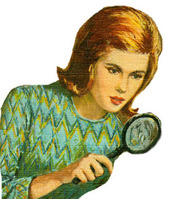
I’m not talking about the newer series post-1970s that’s filled with nasty bits and epic romance – my nine-year-old self was quite content with an amorphous Ned who appeared ever few chapters to escort Nancy to a seasonal BBQ or give her an occasion to wear her new taffeta party dress. And as far as violence, for me it was pretty dicey when Nancy was bound, gagged and left to starve.
No, I’m talking about that classic Nancy Drew that lived somewhere in the magical world post-high school but pre-matrimony. Old enough to drive and travel independently, but young enough to still need her dad. And, always, regardless of the situation, mature enough to help others with grace and style
I’m not the only one who thinks so either.
In this NY Times piece, all three women Supreme Court Justices identify Nancy as a formative literary role model. What captured them probably has less to with Nancy’s white middle-class upbringing and more to do with the essence of Nancy herself. As critic Melanie Rehak recognizes, “Nancy was courageous and independent but she never used that independence in an overtly rebellious way. Instead, she used her freedom to have adventures, but they were always in the name of doing good and serving justice.”
And that’s one reason why I’m purposefully directing my daughter to these books. (That and it gives me an excuse to re-read them myself.) I’m not vying for her to be a Supreme Court Justice one day—heaven knows we don’t need the High Court adjudicating whether or not Barbie Fairytopia is in copyright infringement of Disney’s Pixie Hollow—but I do want her to have a robust view of womanhood. I want her to know how to bake a cake for the elderly neighbor next door and have the guts to chase away the intruder who’s trying to steal said neighbor’s family silver. I want her to be smart and kind, pretty and unpretentious, appropriate and daring. I want her to be forgiving and humble, gracious and accomplished.
All at the same time.
Certainly I’m not conferring faith or belief on Nancy. And maybe it’s simply an example of common grace, general revelation, or the two times a day that the stopped clock is right, but a lot that I learned about womanhood came from having Nancy Drew in one hand and my Bible in the other. And the more I read the latter, the more I’m realizing that true womanhood isn’t an either/or proposition.
More than likely, it’s both/and.
It’s women with a hammer in one hand and a baby in the other. It’s women with the wisdom to defer an angry king and the kindness to minister to the King of Kings. It’s women with strength to lead and the humility to follow. And it’s women with the grace to move in society at the very time that they are turning the world upside down.
I’m from a generation that is quick to throw off anything that we don’t deem significant whether it’s marriage, motherhood, or social propriety. But I’m also from a generation that is perilously divided and grotesquely caricatured by our private definitions of what it means to be a woman. Perhaps the truth lies somewhere with a powder blue convertible, a twin set, and a pair of pumps. So as for me, don’t be surprised if you peek in the back of my minivan while I’m ferrying my children around town and see an overnight case packed with a change of clothes, pajamas, a toothbrush, and a bathing suit.
Just in case.
God's Dolls
“Why are we here? I mean, why are we made the way we are—why do we have hands, why do we have feet? Why do I have to go to school? Why do we sit in seats? I mean, WHY?”
He’ll never make that mistake again.
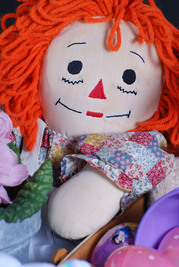
As long as I can remember, she’s been this way, and whether it’s nature or nurture or some complicated interplay between the two, I don’t know. But just like me, she prone to distraction and going “off with the faeries.” A couple years ago, while she was swinging, gazing up into the sky, her baby-fine hair blowing in the wind, legs pumping against the air, she abruptly exclaimed: “I know-- maybe… maybe the world is like a great big dollhouse. And people are God’s dolls. Maybe we’re just God’s dolls!” Or maybe, like her mama, she needs to learn how to have a little fun now and again without over-analyzing everything.
But what if she’s right—are we just God’s dolls?
Over the last few years, many of us have gained a renewed vision of God’s sovereignty and His overwhelming majesty. We’ve
And it’s wonderful. That is, until life gets difficult, until suffering comes. And then suddenly we have to wrestle with a God who would allow our pain for His own glory.
But we know enough to be consistent and our theological construct has taught us that our good comes from pursuing His glory; so even in life’s soul-wrenching moments like the death of a marriage or losing a child we never even had the chance to hold, we say to each other, “Though he slay me, yet will I trust in Him.” We sing "I long for nothing else as long as You are glorified” and we bless the name of the Lord even as He gives and takes away.
But I’ll be honest, I find those kinds of things very hard to say and even harder to believe without sounding somewhat insincere and inhuman.
The tension comes, I think, not from our talking about God’s glory but from our talking about it about in isolation, apart from everything else that He has revealed about Himself. In this one-dimensional approach, if we’re not careful, we can quickly make Him out to be some kind of cosmic bully that we have no choice but to submit to. He’ll be just like all other pagan gods who use people to make themselves look better. And we’ll end up dehumanized in the process because in order to embrace this kind of god—who would glorify himself at his creature’s expense—we’ll have to cauterize our own hearts against suffering and ultimately become callous to the pain of others. It will simply be “God’s will” for their lives.
But this is not our God.
He is not one-dimensional, and neither are we. We are not His pawns; we are not stock characters in His drama; we are not His dolls. The deeper magic is this: While our good is found in seeking His glory, it is His glory to bring about our ultimate good. This is what makes Him distinct, this is what sets Him apart—He chooses to glorify Himself by loving His children.
This does not mean that He will always shield us from pain or that we won’t endure the trials of this life. But it does mean that in them, He has an overarching purpose and that in them, He Himself will walk beside us. We may wrestle with Him at Peniel, but He won’t walk away until He blesses us.
And ultimately this is why we trust Him—not only because He has the power to work all things out for His own glory—but because it is His glory to work them out for our good. So when the trials come, yes, we should sing “as long as you are glorified," but only because we know that what glorifies Him most is loving us in ways that we can’t even begin to imagine.